
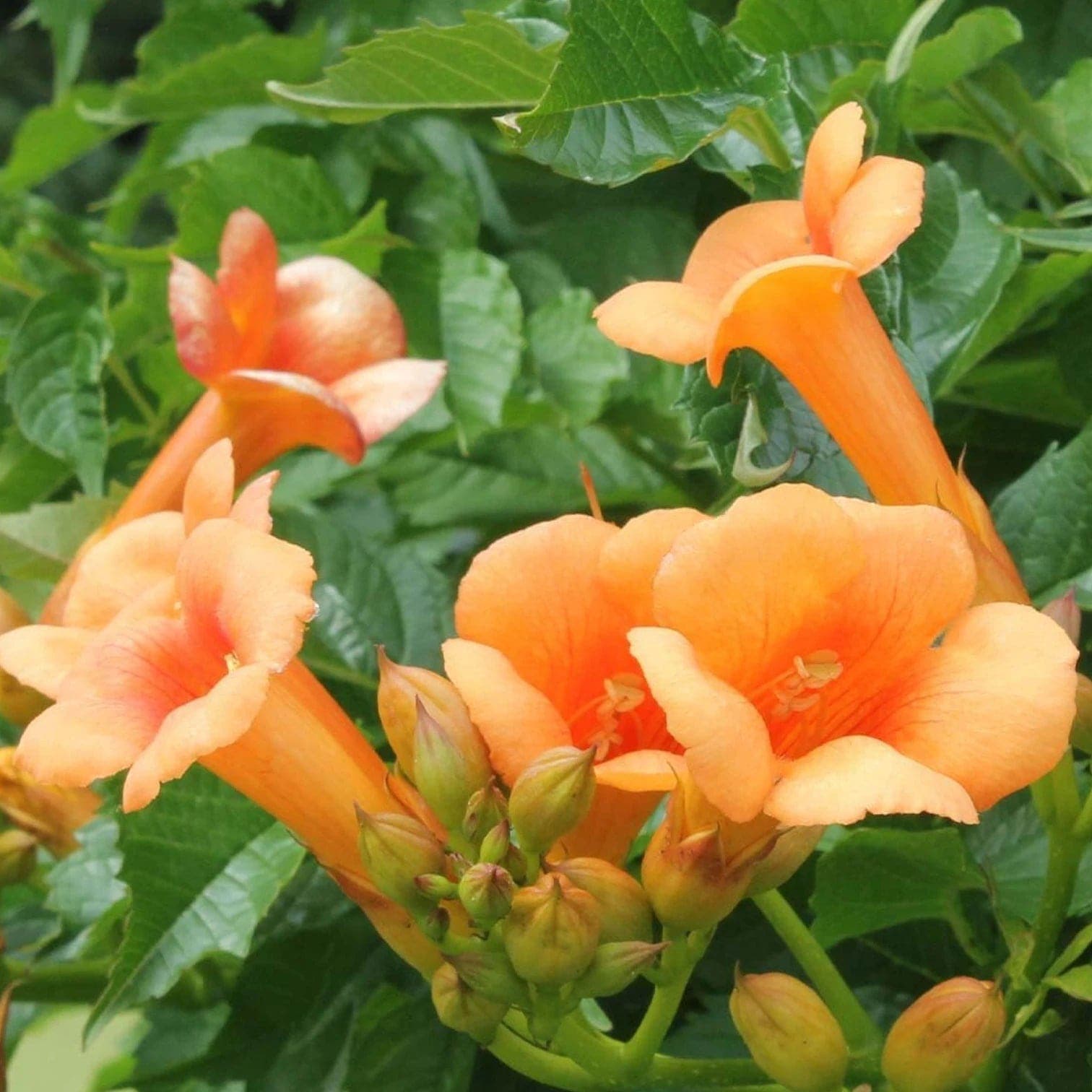
Campsis × tagliabueana 'Madame Galen'
20,70 €
Livré chez vous par Jardiplants, un service Renoday.
Description
Campsis × tagliabueana 'Madame Galen': big trumpets for warm walls 'Madame Galen' is one of the best-known trumpet creepers, valued for its broad, reddish-orange tubular flowers and its ability to cover a support with generous summer foliage. It is a deciduous, woody climber that clings with aerial rootlets and builds a substantial framework over time. Flower clusters arrive from summer into early autumn, making it a strong choice when early-season climbers have already finished. This plant rewards planning. Give it a permanent support, a sunny aspect, and a sheltered microclimate, then train it clearly from the start. The result is a long-lived climber with real architectural presence and a reliable late-season flower show. Scale and growth habit: planning for 8-12 m In open ground, 'Madame Galen' can reach 8-12 m in height and spreads 2.5-4 m across a wall, pergola, or large trellis. The mature plant is heavy: thickening stems form a permanent skeleton, while newer shoots extend and flower. If your goal is coverage at a specific height, it helps to guide primary stems horizontally along wires so flowering growth is carried where you can see it. Time to full size is measured in years, with a gradual build-up season by season. Early on, the plant is often more focused on root establishment and framework building. As that structure develops, flowering becomes progressively more generous. Choosing the right position Full sun and shelter are the key drivers. A south- or west-facing wall provides warmth that helps stems ripen and supports better bud formation. Shelter reduces cold wind stress and helps protect new shoots in spring. 'Madame Galen' is tolerant of a wide soil pH range and grows in chalk, clay, loam, or sand, provided the root zone holds some moisture while draining freely. Light: Full sun for best flowering Aspect: South- or west-facing supports stronger performance Exposure: Sheltered sites suit this H4 hardy climber Soil and water: moderately fertile, moist but well-drained A moderately fertile, moist but well-drained soil suits Campsis best. In heavy clay, incorporate grit and organic matter to open the structure; in light sand, add compost to improve moisture-holding. Water well in the first two growing seasons so the plant can build a deep root system, and keep the moisture consistent during prolonged dry periods. Mulching in spring helps in two ways: it buffers moisture and keeps the root zone cooler, while the top growth enjoys the heat of a sunny wall. That temperature split mirrors how many large climbers thrive: cool roots, warm stems, and bright light. Support and training: start early for a clean framework Because 'Madame Galen' becomes substantial, install the support before planting. For walls, a strong wire system fixed with proper anchors is ideal. Tie in young shoots loosely so they can thicken, and spread stems out to prevent congestion. Framework stems: Select a few main leaders and train them where you want permanent coverage Lateral training: Run stems sideways along wires to create flowering points along the length Access: Leave room to reach stems for pruning and tying-in later Pruning: encourage new flowering wood Campsis flowers on new growth. Prune in early spring, once the worst cold has passed, to set up the season’s flowering shoots. Remove any weak or congested stems, then shorten side shoots back to a few buds. That concentrates growth into strong new extensions that carry the flower clusters later in the summer. During the growing season, you can also shorten overly long, soft shoots to keep the outline neat and encourage branching. A balanced structure with well-spaced stems is easier to maintain and flowers more evenly than a plant allowed to pile all its growth into one direction. Feeding: enough to sustain flowering, not force soft growth A spring mulch and a balanced feed at the start of growth are usually sufficient in the ground. In very lean soils, a second light feed in early summer supports extended flowering. In containers, feeding needs are a little higher because nutrients wash through more quickly. Containers and winter protection In a pot, growth stays smaller and slower than in open ground, but the plant still needs a solid frame and consistent watering. Choose a large, stable container and a free-draining mix with a moisture-retentive component. Watering becomes more frequent in warm weather, especially when the plant is in flower. For winter, the plant’s H4 hardiness improves with shelter, and the roots in containers appreciate insulation. Place the pot against a warm wall, wrap the container if cold spells are forecast, and keep the compost lightly moist with free drainage. Common issues to watch for Slow start: First-year growth can be modest while roots establish; steady watering helps Flowering high up: Train stems horizontally to bring flowering growth down to eye level Thin, whippy shoots: Spring pruning and summer tip-pruning encourage branching Dry stress: Deep watering during dry spells supports bud formation and leaf health Flowers and foliage: what to expect through the season The flowers are tubular and flared, carried in clusters and coloured in warm orange-red tones. They sit above a bold canopy of pinnate leaves made up of many small leaflets, which gives the plant a lush, layered look in summer. Because the foliage is deciduous, winter shows the trained framework clearly-useful when you want to check ties, adjust stems, and plan spring pruning. In favourable summers, flowering runs for weeks and often overlaps with other late-season climbers. A warm wall and steady watering through dry spells make the difference between occasional clusters and a more continuous show. Planting and establishment Plant with the crown at the same level as it sat in the pot, then water thoroughly to settle the soil around the rootball. A mulch helps in the first two years, particularly on sunny walls where the root zone can dry quickly. If you are planting beside paving or a wall footing, leave a little space so rain can reach the root area and irrigation can soak in around the base. First summer: Focus on training main stems and keeping moisture consistent Second summer: Expect stronger extension growth and more flowering shoots After establishment: Spring pruning and steady moisture support repeat performance If you have a sunny wall and want a climber that finishes the summer with a bold trumpet display, Campsis × tagliabueana 'Madame Galen' is built for the job.