
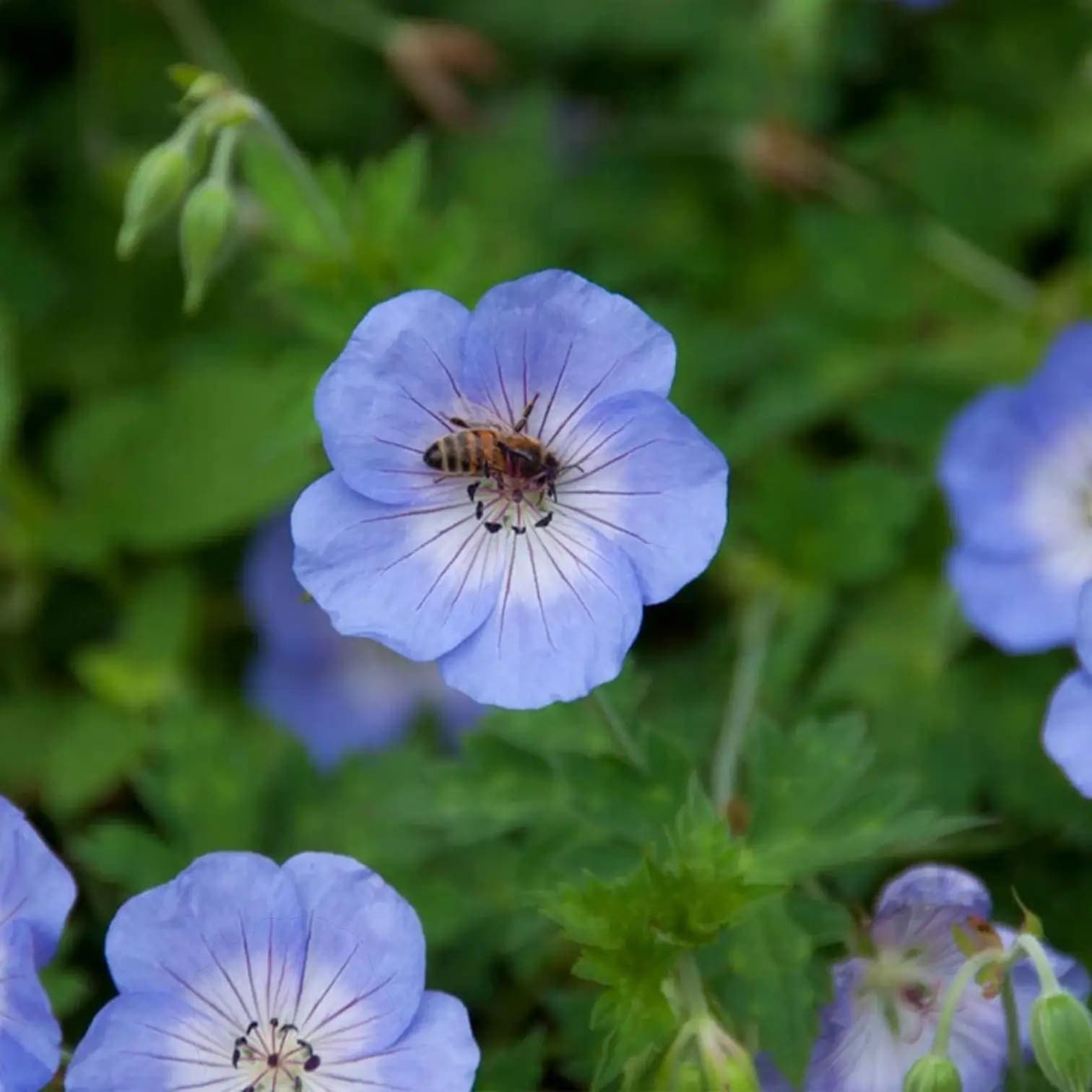
Geranium 'Johnson's Blue'
13,80 €
Livré chez vous par Jardiplants, un service Renoday.
Description
Geranium 'Johnson’s Blue' for relaxed blue summer planting Geranium 'Johnson’s Blue' is one of those hardy cranesbills that earns its space through colour, coverage and a natural, easy shape. It forms a low to mid-height mound of deeply divided green leaves, then sends up open, saucer-shaped flowers in a clear blue-violet tone through late spring and summer. Growth is spreading but still soft, so the plant can knit around roses, shrubs, taller perennials and path edges in a loose, informal way. In open ground, mature plants can reach roughly 10-50 cm high and 50-100 cm wide, with the flowering stems sitting above a leafy base. The effect is informal and generous. Flowers are large enough to read from a distance, while the dissected leaves keep the plant useful before and after the main bloom period. Geranium 'Johnson’s Blue' works especially well where borders need seasonal colour close to the ground: at the front of a perennial bed, along a sunny path, beneath airy shrubs, or between later-flowering plants that need a living filler around their stems. It is herbaceous, so top growth dies back naturally as the season closes and returns from the crown in spring. Where Geranium 'Johnson’s Blue' grows best outside Full sun gives the brightest flowering in many gardens, while partial shade keeps the foliage fresher during warm, dry spells. A position with morning sun and some afternoon shelter can be very effective in hotter courtyards or exposed balconies. Soil should be moderately fertile and free from winter waterlogging. Moist but well-drained loam is ideal, though this cranesbill is adaptable across chalk, clay, loam and sand when the structure allows surplus water to move away from the crown. For border planting, loosen a broad planting area around the root ball and blend in compost only where the ground is very poor. Heavy clay benefits from structural improvement and raised planting if winter wet collects in the area. Sandy soils can support Geranium 'Johnson’s Blue' well when moisture is held consistently during establishment. After the first full growing season, plants usually cope with ordinary weather shifts, though prolonged drought can reduce flower production and leave foliage tired early. Planting distance, spread and container reality Use the mature spread as the practical spacing guide. In open ground, allow around 100 cm for a full, mature plant where a single specimen has room to broaden. For faster cover, several plants can be set closer, with the expectation that stems will overlap sooner and light trimming may be useful after flowering. Around roses or upright shrubs, keep the crown clear at planting and let new growth expand outward as roots establish. Containers keep Geranium 'Johnson’s Blue' smaller and slower than open ground, especially where root space and summer moisture are limited. Use a wide container with drainage holes and a peat-free, outdoor-suitable mix with mineral structure added for airflow. A bowl or low planter suits the mounded habit, while a deeper patio pot gives roots more stable moisture. Container plants need more regular checks through warm weather because the leafy canopy can pull moisture from the root zone quickly. Open-ground size: around 10-50 cm high and 50-100 cm wide at maturity. Pot behaviour: usually more compact, with fewer flowering stems if root space is tight. Planting use: border fronts, path edges, shrub underplanting and relaxed perennial gaps. Watering, feeding and seasonal rhythm Water newly planted Geranium 'Johnson’s Blue' thoroughly, then keep the root zone evenly moist while new roots move into the surrounding soil. In borders, use deep watering during dry spells so the full root zone is moistened. Once established, the plant usually needs extra water only during extended drought or in very free-draining soil. In pots, water when the top 30-40% of the pot depth feels dry, then soak the full root ball and let excess drain away. Feeding should stay modest. A spring mulch of mature compost or a balanced slow-release fertiliser is usually enough for healthy flowering and leaf renewal. Heavy feeding can push lush, soft growth that flops earlier. If the plant is used near roses or larger shrubs, make sure mulch stays around the soil surface and away from the crown itself, so the base remains airy and clean. In planting schemes, pair Geranium 'Johnson’s Blue' with upright forms that can rise through or behind it. Salvia, Nepeta, roses, ornamental grasses and taller hardy perennials all benefit from its lower, cooling flower colour. The plant is also useful between spring bulbs, because its expanding leaves help cover fading bulb foliage while the first cranesbill flowers open. Cutback and problem patterns for Geranium 'Johnson’s Blue' After the main flush of flowers, remove spent stems and tired leaves to encourage a cleaner second phase of growth. This cut can be light, taking only the flowered stems, or firmer if the mound has collapsed after heat or rain. Fresh leaves usually return from the base when moisture and temperatures are suitable. At the end of the growing season, old herbaceous growth can be cleared once it has browned, or left briefly for winter texture before a spring tidy. Most problems come from wet crowns, very dense shade or exhausted container compost. Persistent winter wet can weaken roots, while dry pots may lead to limp stems and a shorter flowering period. Powdery mildew can appear in warm, dry air with poor airflow, especially when roots are also dry. Vine weevil larvae are a container risk for many hardy perennials, so sudden collapse in a pot deserves a root check. In open borders, division every few years in spring can renew old clumps and provide fresh planting pieces.