
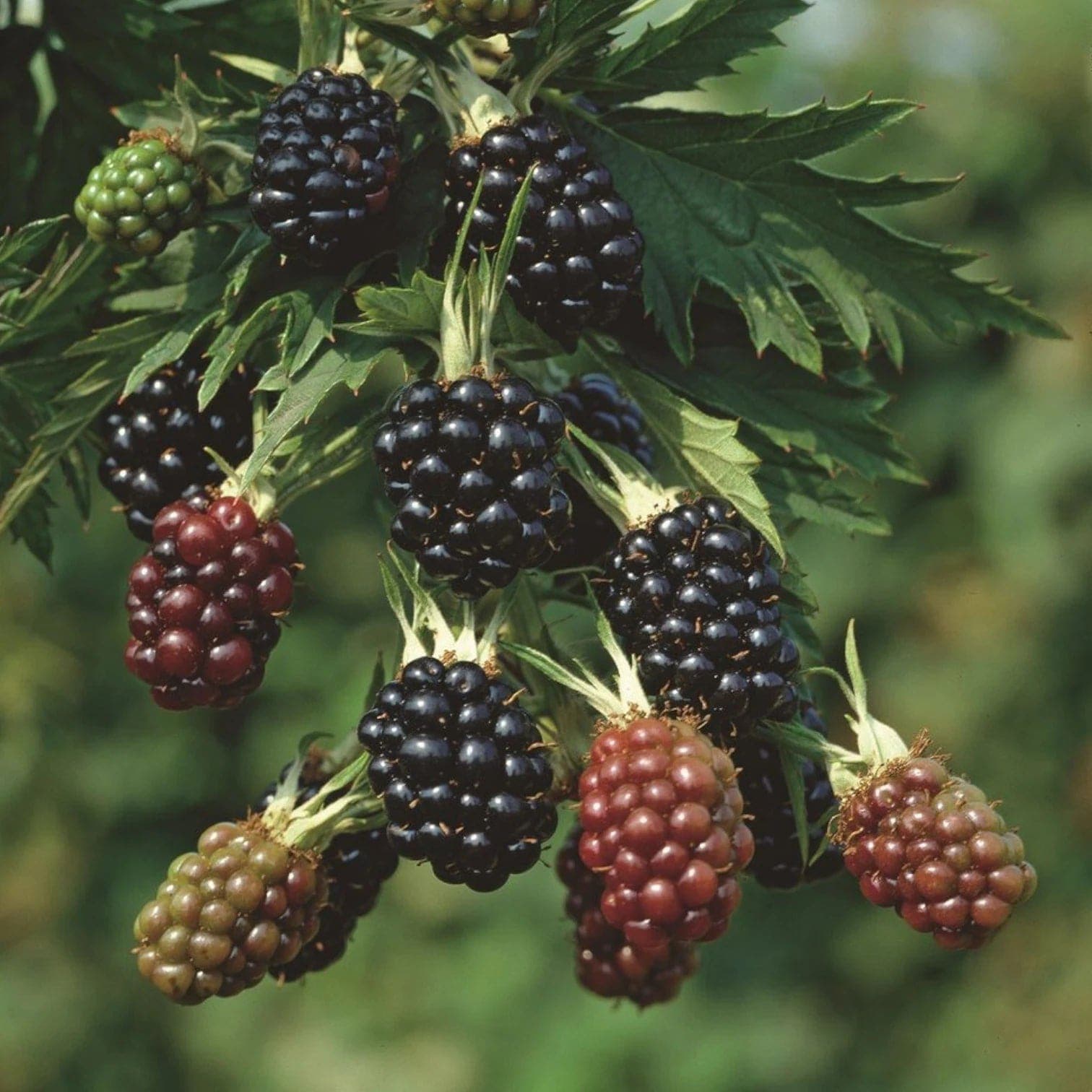
Rubus fruticosus 'Thornfree'
13,80 €
Livré chez vous par Jardiplants, un service Renoday.
Description
Rubus fruticosus 'Thornfree': thornless blackberry for trained fruiting canes A thornless blackberry for accessible harvests Rubus fruticosus 'Thornfree' is a mid-season blackberry selected for smooth canes and practical harvesting. The plant forms long arching stems that carry small white to pale pink flowers in summer and black fruit from late summer into early autumn. Its main value is straightforward: productive blackberry growth with much less snagging during tying, pruning and picking. That makes it especially useful along a fence, wire system or warm boundary where a fruiting plant needs to stay accessible. The plant still behaves like a blackberry, with vigorous canes that need direction and a clear support system. Once the canes are tied in, Rubus fruticosus 'Thornfree' becomes easy to harvest: old fruiting canes are removed after cropping, while fresh canes are trained for next year. This annual rhythm keeps the plant productive and prevents the fruiting area from turning into a tangle. Growth habit, size and support Rubus fruticosus 'Thornfree' normally reaches about 150 to 250 cm high and 100 to 150 cm wide when trained. Canes can extend beyond that if left loose, so spacing should be based on the trained framework and access path. A two or three-wire support along a fence is enough for most gardens. Tie new canes in as they grow, spacing them so air and light can reach the crop. Good access also matters when ripe berries need picking every few days. Containers keep Rubus fruticosus 'Thornfree' smaller and slower than open ground, but the plant still needs a large pot and a fixed support. A free-standing obelisk can work for a young plant, although a wall or rail is usually more stable for mature canes. The container should be heavy enough to resist wind movement once the canes are leafed out. Fruiting blackberries in pots rely on regular watering and feeding because their root area is limited. Soil, position and planting use Rubus fruticosus 'Thornfree' grows best in fertile, moisture-retentive, well-drained soil. Sun gives the strongest ripening, while light partial shade is workable where summers are warm and airflow is good. Soil pH can be acid, neutral or alkaline, and the plant is tolerant of many garden soils if moisture and drainage are balanced. Dry, thin soil can reduce berry size, while cold saturated soil weakens canes and roots. For pot culture, water when the top 25 to 35% of the pot depth has dried, then water deeply. Use a full soak that reaches the lower root zone; shallow daily splashes leave too much of the root area dry. In open ground, mulch around the base after watering to support steady root moisture. Keep mulch away from the cane bases so the crown stays open. Pruning and cropping cycle Rubus fruticosus 'Thornfree' fruits on two-year-old canes. The simplest method is to separate new canes from fruiting canes through the growing season. After harvest, cut the canes that carried fruit down at the base and tie the young canes onto the support for the following year. This keeps productive wood young and makes the whole plant easier to inspect. Training canes horizontally or in a fan shape improves picking and helps light reach the berries. Strong new canes can be guided along the top wire during summer, then arranged into their final positions after the crop is finished. Flowering and fruiting are strongest when old stems are cleared after cropping. A tidy framework also reduces wet, shaded pockets around ripening fruit. What to expect in the first years Young Rubus fruticosus 'Thornfree' plants usually spend the first season building cane strength and roots. A heavier crop follows once the plant has established a good framework. Berries are ripe when they colour fully black and detach easily. Pick gently and often, because ripe blackberries soften quickly in warm weather. Seasonal leaf retention can vary, and the plant may behave as semi-evergreen in mild areas. Leaves can mark or drop in winter without indicating failure. The productive structure is in the cane system and crown. With a sunny position, fertile soil, steady watering and annual cane renewal, Rubus fruticosus 'Thornfree' is a strong choice for edible gardens where the crop should be reachable and the maintenance rhythm clear. Planting position and harvest planning Rubus fruticosus 'Thornfree' is easiest to live with when the support is installed before the canes become long. Two sturdy posts with horizontal wires give a clear harvest wall and let the plant use vertical space along a boundary. In smaller gardens, this makes strong use of vertical space along a boundary. Good access on the front side is important, because berries ripen over a period and picking happens in several rounds. Planting partners should stay low around the base so new canes can be seen and tied in. Strawberries, low herbs or seasonal annuals can sit nearby, but strong perennials around the crown will make pruning harder. Rubus fruticosus 'Thornfree' suits edible planting where thornless canes make training and harvesting easier. It still needs annual cane work, yet the lack of thorns makes training, tying and picking more comfortable during regular maintenance. The first year after planting is mainly about root establishment and building a balanced cane framework. A modest first crop is normal. Once the support is filled with healthy new canes, harvest volume improves and the plant becomes a more reliable part of the edible garden.