
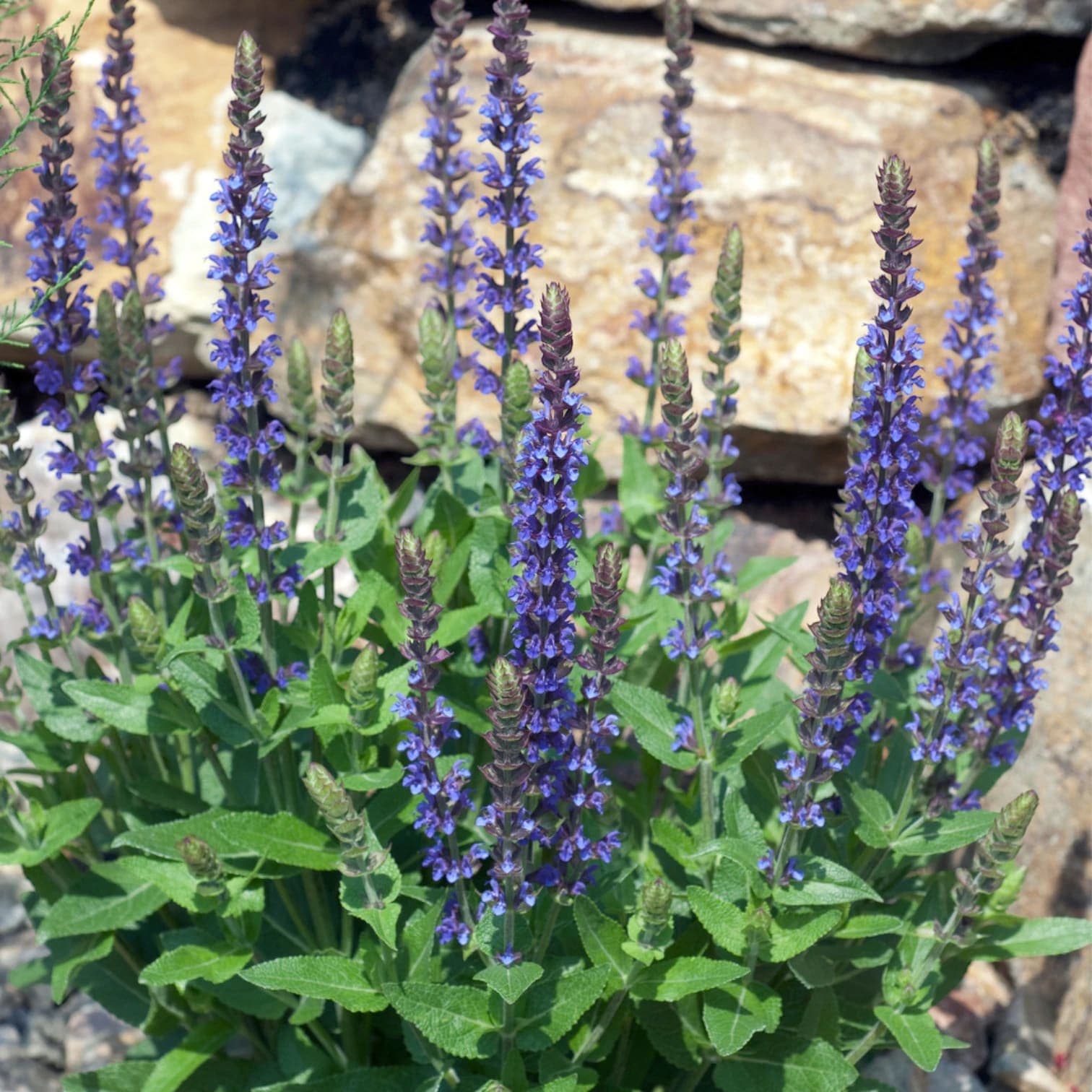
Salvia nemorosa 'Ostfriesland'
13,80 €
Livré chez vous par Jardiplants, un service Renoday.
Description
Salvia nemorosa 'Ostfriesland': compact violet sage for sunny edges Compact violet colour with a strong border line Salvia nemorosa 'Ostfriesland' is a hardy perennial sage known for compact growth and dense violet-purple flower spikes. It forms a tight clump of aromatic foliage, then sends up upright flowering stems from late spring into summer. The effect is clean and vertical, which makes it especially useful along paths, through gravel planting or at the front of sunny perennial borders. It gives colour without needing a large footprint. This cultivar is often valued for its neat scale. It can be used repeatedly to draw the eye through a planting, or grouped with ornamental grasses and drought-aware perennials for a light, meadow-style effect. Bees and other pollinating insects visit the flowers, especially when several clumps are planted together. The plant remains practical after flowering because it responds well to a trim, returning to a green mound that still holds the edge of the border. Scale, clump shape and spacing Salvia nemorosa 'Ostfriesland' is usually around 30 to 45 cm high with a spread of roughly 25 to 30 cm in well-drained garden soil. Its compact scale allows closer spacing where a linked line is wanted. In a mixed border, leave enough space around the clump for air movement and for the first flower stems to rise cleanly. A spacing of about 30 cm suits edging and repeated groups. Containers keep Salvia nemorosa 'Ostfriesland' smaller and slower than open ground, which suits troughs, patio pots and sunny balcony planting. A container-grown plant still needs root depth and drainage. Pair it with plants that prefer similar conditions, such as compact grasses, thyme, low sedums or silver-leaved perennials. A crowded mixed pot can shorten the flowering window if the salvia crown is shaded. Position, soil and watering Full sun gives Salvia nemorosa 'Ostfriesland' its strongest flowering and firmest stems. Soil should be well drained, with dry to medium moisture once established. It can grow in average garden soil, and it performs particularly well where the root zone stays free-draining through winter. Moist, gravelly or sandy soils with good drainage are a strong match. In fertile soil with too much shade, stems can lean by midsummer. For pots, water when the upper 30 to 40% of the pot depth has dried, then soak evenly. The plant can handle short dry spells once established, but a pot that dries hard during bud formation will flower less well. In open ground, water new plants through establishment, then focus on long dry periods. Keep winter drainage open around the crown. Trimming and seasonal care After the first flower flush, cut spent spikes back to healthy foliage. This keeps the clump tidy and can bring a later scattering of bloom. If the whole plant looks tired after flowering, trim it back more evenly to basal foliage, then water if the weather is dry. The aim is a clean mound that can rebuild, with old stems cleared away from the middle of the border. Old stems can be cleared in late winter or early spring as new growth appears. In mild areas, some basal foliage may remain through winter, while colder gardens leave a smaller crown. Division in spring can refresh older clumps if the centre becomes sparse. Replant divisions into open, drained soil and water them in. Placing Salvia nemorosa 'Ostfriesland' in sunny planting This plant is best where its compact rhythm can be seen close up: along a path, beside steps, around a terrace edge or in the front third of a sunny border. It combines well with pale grasses, Achillea, Stachys, Nepeta and compact Lavandula. Its violet spikes can also lift edible-herb style plantings where the soil is sharp and sunny. Seasonal performance usually traces back to light or drainage. Soft, open growth often means shade or overly rich conditions. Sparse flowering can follow a dry pot during bud formation. Winter crown loss is more likely in saturated soil. With sun, a drained root zone, simple after-flowering trimming and a spring cleanup, Salvia nemorosa 'Ostfriesland' is a dependable small perennial for crisp summer colour. Design value through repetition Salvia nemorosa 'Ostfriesland' is particularly effective when repeated in measured gaps. The short violet spikes create a line that guides the eye, while the compact foliage keeps the base of the planting tidy. In gravel gardens, it can sit among low silver foliage and fine grasses. In cottage-style borders, it works among hardy geraniums, Achillea and small alliums. The colour is strong enough to be visible from a distance, but the plant is small enough to use near paths and terraces. Salvia nemorosa 'Ostfriesland' keeps a neat habit and a long useful season with a simple rhythm. Spring growth is compact, early summer brings flowers, trimming resets the clump, and late-season foliage remains low and tidy. In a pot, Salvia nemorosa 'Ostfriesland' can act as a repeat plant across several containers, linking a patio together without using large shrubs. The main planning point is drainage. If the planting site is sunny and the soil lets winter water move away, this salvia is straightforward. For dense or slow-draining soil, a raised bed or container gives precise control over the root zone. For a finished look, plant it in odd-numbered groups and leave a narrow gap from path paving so rain splash and foot traffic stay away from the crown. That small detail keeps the front edge cleaner and gives the violet spikes enough room to stand upright during the main flowering period.