
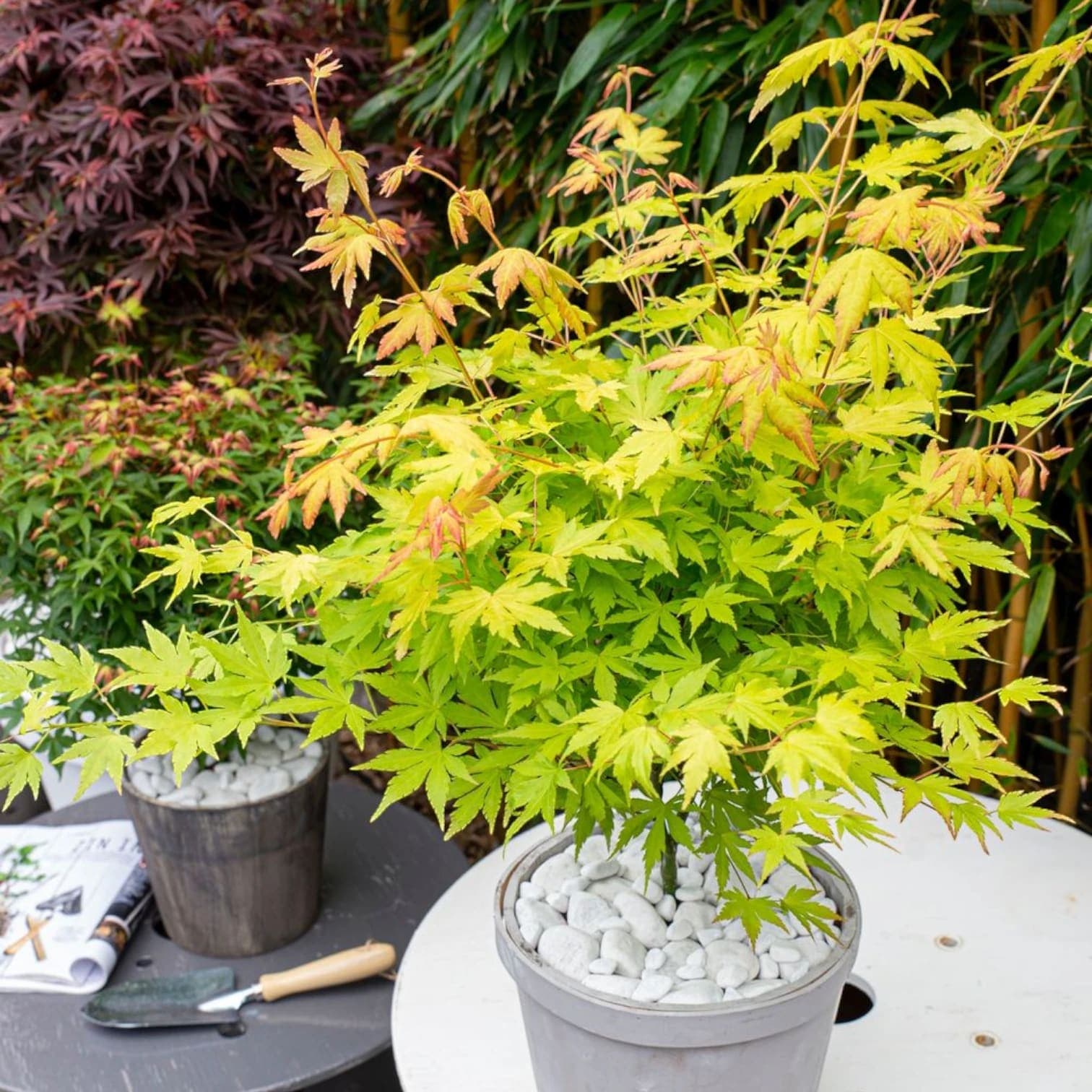
Acer palmatum 'Orange Dream'
20,70 €
Livré chez vous par Jardiplants, un service Renoday.
Description
Acer palmatum 'Orange Dream' is selected for warm spring colour and a long season of changing tones. Leaves open orange-yellow, settle into fresh green through summer, then move into yellow and orange shades in autumn. Fine branching and small leaves keep the plant detailed, so it works especially well near paths, seating areas, and entrances where foliage is seen up close. In open ground, Acer palmatum 'Orange Dream' matures as a shrub or small tree, ultimately reaching 2.5-4 m in height and spread. In a container, growth is slower and the final size stays smaller than plants grown in the ground, which makes it a strong option for courtyards and patios when the pot is large and moisture is managed well. A colour sequence from spring to leaf-fall Colour is the main reason to choose this cultivar, but the effect is most convincing when the plant is healthy and well-sited. Warm spring tones are strongest on new growth, then the canopy settles into a bright green that keeps the plant looking fresh. In autumn, cooler nights bring the yellow-orange finish that gives the plant its name and keeps it prominent when many borders begin to fade. Position, shelter, and light Sun to part shade suits Acer palmatum 'Orange Dream'. Part shade often helps foliage stay clean through summer, especially in hot regions or in reflective courtyard sites. Full sun can work when the root zone stays reliably moist and the plant has some protection from drying wind. A sheltered position also reduces the risk of leaf edge marking during heat and wind events. Light: sun to part shade Exposure: sheltered Best locations: feature borders, mixed shrub planting, and large containers Soil: moisture-retentive and well-drained This cultivar grows best in moist but well-drained soil. It tolerates chalk, clay, loam, and sand as long as the soil structure supports both drainage and moisture holding. Organic matter is particularly useful: it improves water retention in sandy soils and helps open heavy ground so roots have air as well as moisture. Soil reaction is best in acid to neutral conditions. In more alkaline ground, regular mulching and organic matter additions help keep nutrients available and support active feeder roots near the surface. Planting and establishment care Plant in autumn or spring, when soil is workable and moisture is naturally available. Place the root ball level with surrounding soil, water thoroughly to settle it in, and keep the root zone consistently moist through the first growing season. A wide mulch ring reduces competition and buffers temperature swings in the surface root zone. Mulch: 5-8 cm of composted bark or leaf mould Watering: deep watering in dry periods until growth is steady Feeding: light spring compost top-dress; heavy feeding is rarely needed Pruning and shaping Acer palmatum 'Orange Dream' naturally develops a graceful framework. Pruning is mainly for structure: remove damaged wood, thin crossing branches, and refine the outline. Work in dormancy (late autumn through winter). Gradual shaping over several seasons produces a natural silhouette and keeps the canopy open enough for good air movement. Container growing for patios and courtyards Large containers suit this cultivar very well, especially where the spring colour is enjoyed at close range. Use a stable mix that holds moisture but drains freely, and choose a pot with generous drainage holes. In pots, roots experience colder winter swings and faster drying in summer, so watering and winter insulation are key parts of success. Pot mix: loam-based compost with added bark and a mineral component for structure Watering: check frequently in warm weather; water thoroughly until excess drains Repotting: refresh compost every few years; light root pruning keeps vigour when pot size stays constant Winter: insulate the pot or move it into a sheltered corner to protect roots Hardiness and winter protection Acer palmatum 'Orange Dream' is fully hardy in temperate gardens, with the main winter challenge being root exposure in containers. Pots cool down faster and warm up faster than ground soil, so placing containers in a sheltered corner and insulating the pot sides helps keep roots steadier through freeze-thaw cycles. In the ground, a mulch layer supports roots and helps keep soil temperature more even. Spacing and mature shape With an ultimate spread of 2.5-4 m, this cultivar benefits from space where the outline can be appreciated. If a tighter footprint is needed, container culture and gradual crown refinement keep the plant smaller and more compact. In borders, leaving open space around the canopy helps light reach the inner framework and supports better air movement. Suggested spacing: 3-4 m from other shrubs for a clear silhouette Training: gradual canopy lifting and light thinning can highlight branching and reduce shading in the centre Seasonal snapshot Spring: orange-yellow new growth becomes the main feature Summer: foliage settles into fresh green; consistent moisture supports leaf quality Autumn: yellow and orange tones return as nights cool Winter: bare framework carries structure, especially when lightly lifted Potential problems and practical fixes Leaf scorch can appear during hot, dry weather, especially when wind and strong sun combine with a dry root zone. Shelter, mulching, and consistent moisture help keep foliage in good condition. In soils that remain wet for extended periods in winter, root stress can develop; improved drainage and planting on a slight mound can support healthier roots. Aphids and scale insects may appear on soft spring growth. Natural predators are often effective. Occasional leaf-spot diseases can occur in humid summers; good air movement through the canopy helps keep it minor. Garden use and pairing Acer palmatum 'Orange Dream' works as a focal plant where seasonal colour is appreciated up close. Pair it with evergreen structure (yew, box substitutes, or low conifers) to set off spring and autumn colour, and use shade-tolerant perennials and grasses to fill the base. In mixed borders, it blends well with hydrangeas, ferns, and woodland perennials that share similar soil moisture preferences.