
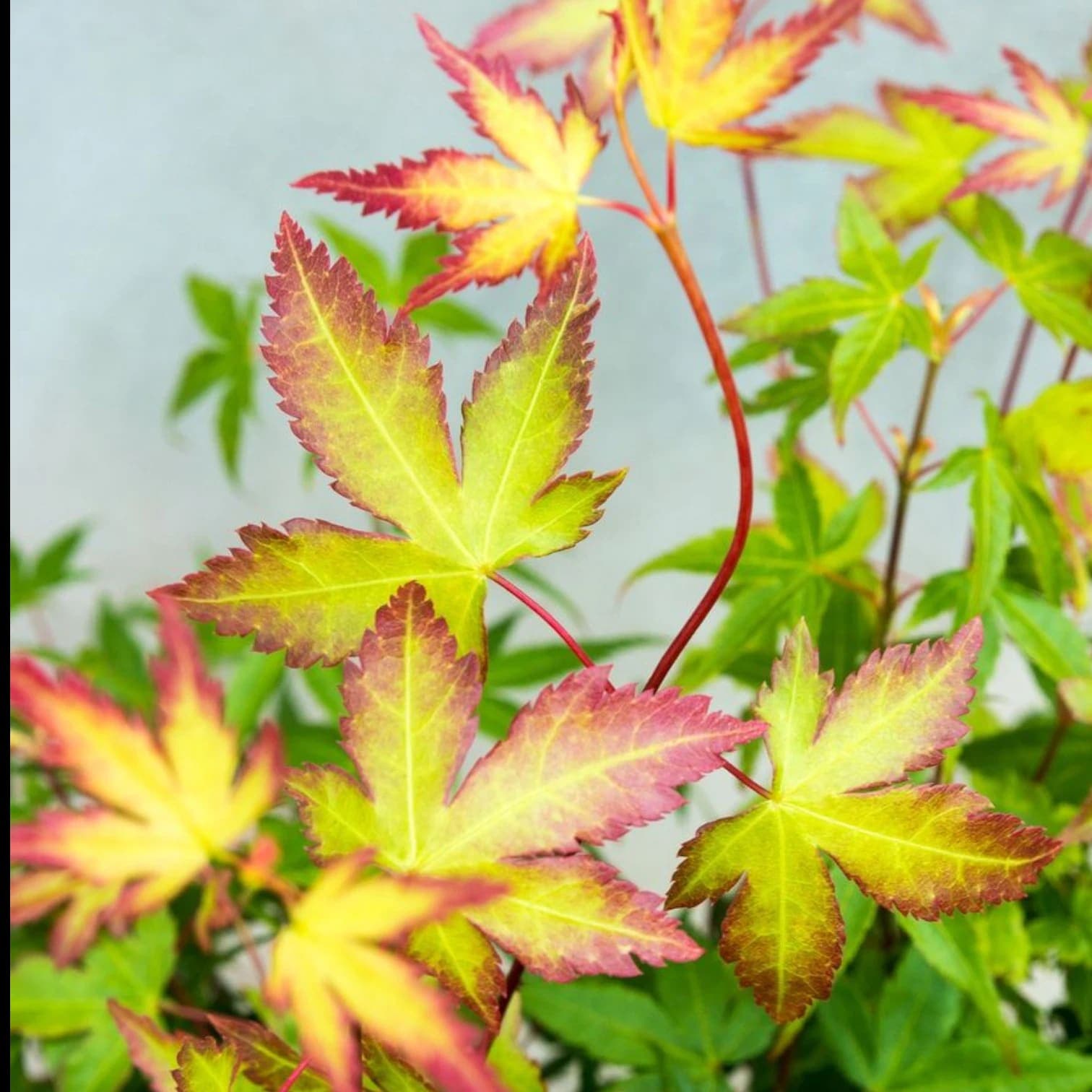
Acer palmatum 'Little Princess'
40,02 €
Delivered to you by Jardiplants, a Renoday service.
Description
Acer palmatum 'Little Princess' is a compact Japanese maple built for small spaces. Fine, delicately lobed leaves and slow extension growth keep the plant tidy, making it well suited to patios, courtyards, and the front of borders. New growth can carry a subtle warm edge before settling into summer green, with autumn colour arriving as temperatures drop. In open ground, Acer palmatum 'Little Princess' typically reaches around 1.5-2.5 m in height and 1-1.5 m in spread at maturity. In a container, growth stays slower and the plant usually remains smaller than in open ground, especially when the root system is refreshed every few years. That combination of small leaves and steady, compact growth also suits bonsai and trained forms. Close-range texture in Acer palmatum 'Little Princess' Acer palmatum 'Little Princess' keeps a fine texture where it’s seen up close: small leaves, neat branching, and a low, mounded outline that stays proportional as it matures. Near paths, steps, or seating, the canopy reads as detailed and calm, and the small-scale branching makes shaping and training straightforward. Placement and microclimate Sun to part shade suits this cultivar, with shelter improving leaf quality through summer. Morning sun with afternoon shade often provides a balanced result, particularly in warmer regions or in very reflective courtyards. Wind protection helps keep leaf edges clean and reduces moisture loss from the canopy. Light: sun to part shade Exposure: sheltered positions support the best foliage finish Where it fits: patios, small gardens, courtyards, and Japanese-style planting Soil and potting mixes Acer palmatum 'Little Princess' performs best in moisture-retentive, well-drained soil. In the ground, a loam enriched with organic matter supports steady growth. In containers, a loam-based compost with added bark and a mineral component helps keep structure and drainage stable over time. A mulch layer (bark, leaf mould, or composted material) buffers surface roots and helps keep the root zone evenly moist. Soil reaction is best in acid to neutral conditions. When local ground trends alkaline, regular organic matter and mulching help create a stable, root-friendly layer close to the surface where feeder roots are most active. Establishment in the first season Planting in autumn or spring gives roots time to establish before the demands of summer. Set the plant at the same depth it grew in the pot, water thoroughly, and keep the root zone consistently moist through the first growing season. A wide mulch ring reduces competition and makes watering more efficient. Watering: deep watering during dry spells until the canopy feels stable and growth is steady Mulch: 5-8 cm, kept clear of stems Feeding: light spring top-dress with compost is usually sufficient Shaping and refinement This compact maple rarely needs heavy pruning. With Acer palmatum 'Little Princess', most pruning is about refinement: removing any damaged or crossing shoots and gently shaping the outline. Work during dormancy (late autumn through winter). If bonsai training is planned, the small leaves and slow growth make wiring and clip-and-grow approaches practical, with gradual changes producing the most natural-looking results. Long-term container growing Container culture is a strong match for this cultivar. Choose a pot that is wide enough to balance the plant and deep enough to buffer moisture, with generous drainage. In pots, root systems experience larger temperature swings in winter and dry faster in summer, so watering and winter insulation matter more than in the ground. Potting: stable, moisture-retentive mix with good drainage and structure Watering: check more often in warm weather; water thoroughly until excess drains Root care: refresh compost every few years; light root pruning keeps plants vigorous when pot size stays constant Winter: insulate the container or place it in a sheltered corner to protect roots What to watch for Leaf scorch can occur in hot, windy conditions or when the root zone dries quickly, especially in containers. Shelter, mulching, and consistent watering usually keep foliage looking clean. In soils that stay wet for prolonged periods in winter, root stress can develop; improved drainage and soil structure support healthy, fine roots. Aphids can appear on spring growth and may cause light leaf distortion. Natural predators often arrive quickly. Occasional leaf-spot can occur in humid summers; an open crown and good air movement help keep it minor. Hardiness and winter care Acer palmatum 'Little Princess' is fully hardy in typical temperate gardens, yet plants in pots experience stronger temperature swings around the roots. A sheltered corner, pot insulation (wrap, hessian, or placing the pot inside a larger container), and a mulch layer on the compost surface all help buffer cold snaps. Winter watering is occasionally needed in prolonged dry spells, as containers can dry even when air temperatures are low. Year-round rhythm Spring: refresh mulch, check watering as buds break, and top-dress with compost Summer: keep moisture consistent during warm spells, especially for container-grown plants Autumn: enjoy colour change; reduce feeding and keep watering steady until leaf-fall Winter: prune for structure during dormancy and protect pots from repeated freeze-thaw cycles Spacing and garden placement With an ultimate height around 1.5-2.5 m and an ultimate spread around 1-1.5 m, Acer palmatum 'Little Princess' has enough presence to stand alone while still fitting into compact planting. Give it room so the outline stays visible from all sides. In borders, low underplanting keeps the canopy as the main focus and helps maintain air movement around the stems. Suggested spacing: around 1.5 m from other shrubs for a clear outline Good neighbours: ferns, epimediums, hellebores, spring bulbs, and low evergreen structure Near hardscape: pots and paving highlight the fine leaf texture and small-scale branching Using 'Little Princess' in planting schemes This cultivar is ideal where planting has to stay refined. Use it as a repeated accent in small borders, or as a single focal plant in a pot with low underplanting (small ferns, epimediums, or spring bulbs). In Japanese-inspired planting, it pairs naturally with mossy textures, stone, and low evergreens that frame the foliage and highlight the seasonal changes.