
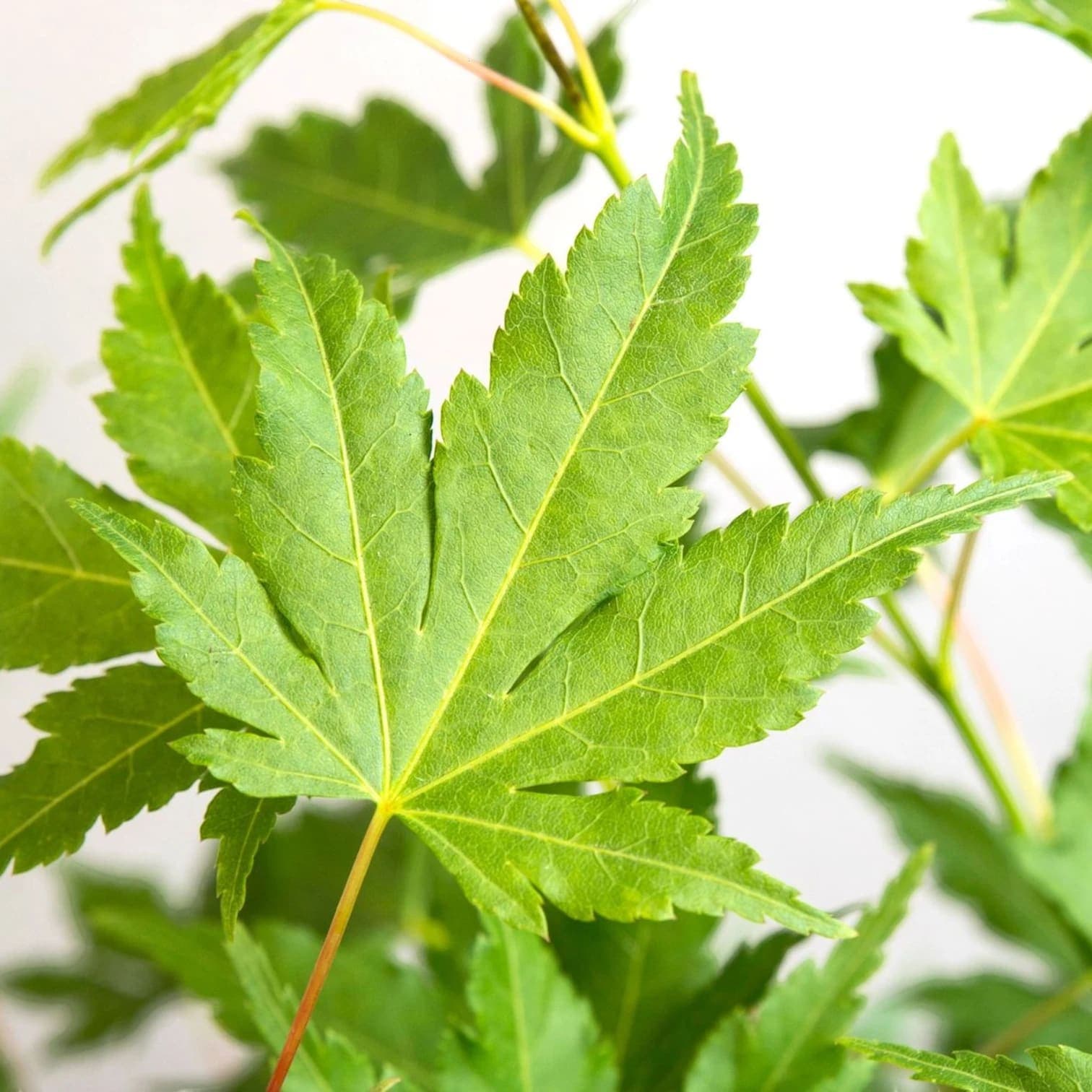
Acer palmatum 'Going Green'
22,08 €
Bij u geleverd door Jardiplants, een dienst van Renoday.
Beschrijving
Acer palmatum 'Going Green' is a green-leaved Japanese maple selected for luminous stems and a clean, rounded canopy. Fresh spring growth opens lime-green, settles into bright summer green, then shifts into orange and red tones in autumn. When leaves fall, green bark and smooth branching keep the outline lively through winter, especially once the lower crown is gently lifted to show the stems. In open ground, this cultivar matures into a substantial small tree, ultimately reaching 4-8 m tall with a 2.5-4 m spread. Planted in a container, growth runs slower and the plant stays more compact than in open ground, which makes it workable for patios and courtyards when the pot is generous and watering is consistent. Green stems that carry the season Stem colour is a defining feature of Acer palmatum 'Going Green'. Young stems glow green and stay clean-looking as the plant ages, creating a bright framework behind the leaves in summer and a clear silhouette after leaf-fall. Leaves are typically seven-lobed with long, pointed segments, giving a crisp texture that reads clearly both up close and across the garden. Light and exposure Sun to part shade suits Acer palmatum 'Going Green'. A sheltered position improves foliage quality, especially in sites with dry wind or strong midday heat. Part shade often keeps the canopy looking fresh through summer, while sun can work well where soil moisture stays reliable. If a site is exposed, plants respond best when placed where a wall, hedge, or larger shrubs break the wind. Best placement: sheltered border, lawn specimen, or woodland-edge style planting Sunlight: sun to part shade Exposure: sheltered, protected from drying winds Soil, drainage, and moisture balance This cultivar grows well in moisture-retentive, well-drained soils. Clay, loam, and sand can all work, provided drainage is steady and the root zone keeps some moisture between waterings. A layer of organic mulch helps buffer summer drying, supports fine root growth near the surface, and keeps soil temperatures more even. Soil reaction can be acid, neutral, or alkaline. In alkaline ground, organic matter additions and a consistent mulch layer help keep root conditions stable and support nutrient availability. On heavier clay, planting on a slight mound and mixing in coarse organic material can improve structure and drainage while still holding moisture. Planting for a strong start Autumn or spring planting gives Acer palmatum 'Going Green' time to root into surrounding soil before summer heat. Set the plant so the top of the root ball sits level with the surrounding ground, then water thoroughly to settle soil around the roots. A wide mulch ring helps reduce competition from grass and keeps the root zone more even in moisture and temperature. First season watering: deep watering during dry spells until new growth feels steady Mulch: 5-8 cm of composted bark or leaf mould, kept clear of the trunk Staking: only when the site is windy or the plant has a tall, top-heavy framework Ongoing care through the year Japanese maples respond best to steady conditions. In most gardens, a spring top-dress of compost and an annual mulch refresh are enough. Feeding can stay light; vigorous fertilising tends to push soft growth that marks more easily in wind and heat. During prolonged dry spells, deep watering supports the canopy and helps keep leaf edges clean. Fallen leaves can be left in place as a light woodland mulch in planting beds, or cleared and composted for future mulch. In lawns, a clear mulch ring around the trunk reduces mowing damage and keeps moisture more reliable around shallow surface roots. Pruning and shaping Acer palmatum 'Going Green' naturally forms a rounded, bushy crown and rarely needs routine pruning. Where shaping is useful, work in dormancy (late autumn through winter) and focus on structure: remove damaged wood, thin crossing branches, and refine the outline with small cuts. If a multi-stem form is preferred, select and keep several strong stems and remove weak competing shoots over time. For a small-tree look, lift the canopy gradually by removing a few lower branches over several seasons. Container growing that lasts Large containers suit Acer palmatum 'Going Green' well, especially on patios where stem colour can be enjoyed at close range. Use a pot with generous drainage holes and a stable, moisture-retentive mix that still drains freely. A loam-based compost with added pine bark and a mineral component (pumice or grit) helps keep structure over time. Pot size: start roomy; a wider pot supports stability and moisture buffering Watering: check frequently in warm weather; water deeply until excess drains Repotting: refresh the mix every few years; light root pruning keeps plants vigorous when pot size stays the same Winter: insulate the container or move it to a sheltered corner, as roots in pots experience colder swings Typical issues and how they show up Leaf scorch can appear in hot, dry weather, especially when wind combines with strong sun and the root zone dries quickly. Consistent moisture, shelter, and a mulch layer usually keep foliage looking its best. In heavier soils that stay wet for long periods in winter, root stress can develop; improved soil structure, raised planting, and reliable drainage support long-term health. Aphids and other sap-feeding insects can appear on soft spring growth. Natural predators often keep populations in check. Good air movement through the crown helps reduce leaf-spot problems in humid summers, while steady watering reduces stress that can make plants more vulnerable. Design notes Acer palmatum 'Going Green' works well as a specimen where stem colour and branch structure can be appreciated. Underplant with shade-tolerant perennials and spring bulbs, or pair with fine grasses and ferns for a layered, woodland feel. In winter, the green framework stands out against darker evergreens and stone, keeping the garden interesting beyond the leaf season.